
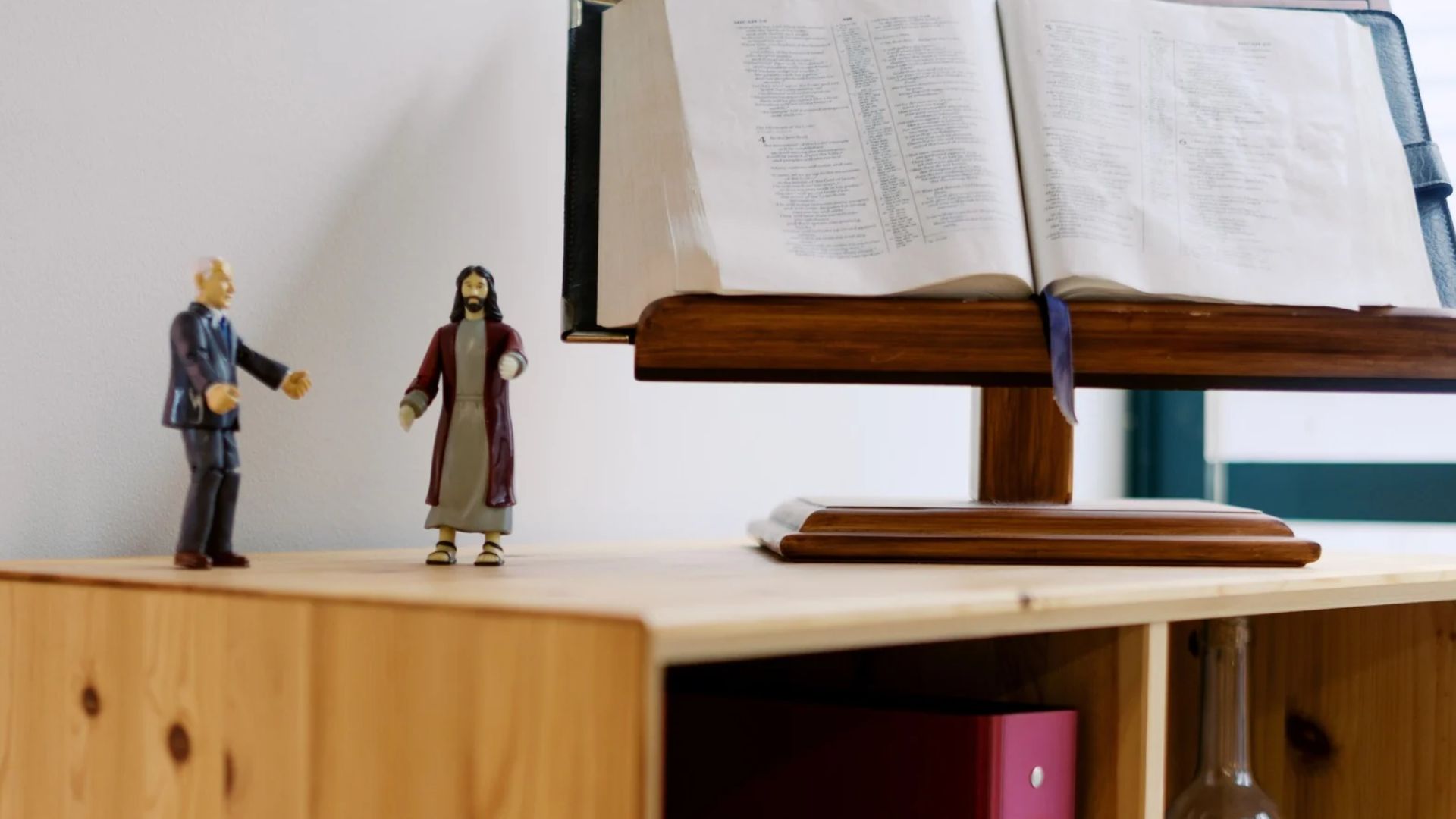
Every psychology student takes theology, and every theology student takes psychology. This cross-disciplinary, integrative training cultivates both depth and difference—expanding your capacity to understand what it means to be human and to meet others in their particularity.
So, The Seattle School is a Christian Seminary. What denomination are you?
We get this question all the time. Officially:
We are a diverse community of faculty, staff, students, and alumni from many Christian traditions, alongside those who approach faith with curiosity, doubt, or distance. Our unity is not uniformity but a shared orientation: we are rooted in the revelatory and redemptive centrality of Jesus Christ.
What this means is that:
1. We’re a multi-denominational seminary. We’ve got students, faculty, and staff representing many Christianities (yes, plural!).
2. We do not require our students to sign faith statements. Students from all backgrounds are welcome at the table. By design, students have classroom experiences consisting of both deep academic engagement as well as the task of wrestling personally and spiritually with course material.We critically engage our lineages and our personal contexts in order to identify both areas of harm and opportunities for healing and restoration.
Now, our faculty and staff do sign faith statements – you can see the verbiage of those here – and also, similarly to our student body, we have a broad scope of theological identities within our teaching and support staff. So: while holding a Christian framework, we acknowledge it is one of many ways to view and engage with the world.
Furthermore, we invite all members of our community to engage one another with a posture of curiosity, respect, and discourse across differences:
In an abiding belief—based on the witness of Scripture—that all people are image bearers of God, The Seattle School affirms the Belovedness of all people, including differences in ability, race, age, ethnicity, economic status, creed, gender identity, and sexual orientation. The Seattle School chooses an intentional posture of dialogue and engagement, with a desire to be a context that bridges differing traditions, perspectives, and cultures toward the possibility of encountering the generous hospitality for all people found in the reign of God. In a divided and broken world, we seek to train people to be agents of hope and healing for individuals and communities. We are a community seeking to recognize, reflect, and engage the dignity, agency, and mutuality of all people, especially those who have been marginalized.
I’m not a believer / I’m agnostic / spiritual but not religious / another faith tradition entirely / atheist – will I be welcome?
Absolutely!
Just like we have a wide representation of “Christianities” in our community, we have students spanning a variety of faith traditions, spiritualities, and “nones” who can philosophically appreciate the power of faith in one’s healing journey, but don’t necessarily need to subscribe. That said, at The Seattle School all students are required to take theology courses that bring us into conversation with Christian texts. Assignments will ask you to develop a deeper understanding of our own worldview, and explore how it does or does not relate to these texts.
Will The Seattle School hold Chrisitan rhythms?
Yes. Our Christian faith is expressed in rhythms that mark the beginning and end of the school year. In the fall, Convocation is our formal beginning together, held at St. Mark’s Episcopal Cathedral in Seattle, where our incoming cohort is officially welcomed into the community, and we celebrate Communion together as a community. Scripture and hymns give structure to this gathering. Similarly, our Commencement ceremony in June incorporates Scripture, hymns, and Christian themes. However, all members of the community are free to participate in these gatherings in ways that honor their own traditions and comfort levels. For example, during the Communion portion of Convocation, anyone who wishes to remain in their seat rather than come forward to receive the elements is free to do so.
There are times when staff or faculty will pray at the beginning of an event, or to mark or enter into a significant moment. But we seek to do so in ways that invite voluntary participation and honor the diverse perspectives and traditions present in the room.
There are often other Christian rhythms recognized by individuals or groups within the community, but participation in these rhythms is optional. For example, Student leadership hosts an annual Fall Vespers service, which is an optional evening event for students.
Will I be trained in biblical or christian counseling?
No, our MACP degree is not a biblical or christian counseling degree. It is a psychology degree that focuses on deep personal formation, relational and psychodynamic theory, and embodied, integrative practice that prepares students for their state licensure exams.
Our MATC students are training towards whatever their professional goals are: our Ministry students might be gearing towards ordination – cross check our course rotation with your governing board to make sure we satisfy your particular requirements, as we have many different denominations in our midst! – but more and more we’re seeing students launch alternative and creative ministries. Our Community Developers might be investigating funding opportunities for launching nonprofits, while our Artists are fine tuning their artists portfolios, and our Chaplains are gearing towards board certification.
Tell me about your curriculum – will I study theology as a psychology student? Will I study psychology as a theology student?
Oh, yeah!
All MACP students will take core interdisciplinary courses, two core theology courses, and one biblical survey course. Students of any and no faith background will engage their own beliefs and the discipline of Christian theology as part of their training to work with people of all belief systems. As is the case across our programs: the goal is engagement not agreement. By learning the approaches and frameworks of both disciplines – counseling psychology and theology – students are equipped to critically and constructively engage in holistic care of those they will serve, whether in ministry, mental healthcare, nonprofit leadership or anywhere they are called to engage serving communities through transforming relationships.
To see this in action, just take a peek at our various course rotations, along with our course schedule!
At The Seattle School we’re very proud of our signature pedagogy – courses distinct to the ethos of The Seattle School – and our particular integration of theology and psychology in an expansive, progressive, and deeply rooted way. Regarding our courses, some of our “Honorable Mentions” include:
Intersections I, II, & II:
Interdisciplinary Inquiry & Psychological Frameworks, Biblical Traditions & Theological Formations, & Textual Integrations
In Intersections I, you’ll be introduced to the realm of interdisciplinary inquiry with psychology as the primary lens. Students will explore and articulate conceptions of personhood and the self, drawing from psychological theories, personal histories, and social location.
In Intersections II, you’ll be introduced to the realm of interdisciplinary inquiry with Christian theology as the primary lens. It will attend to the ways cultural contexts influence interpretive traditions and theological formations.
And in Intersections III, you’ll synthesize the first two Intersections courses. With faculty advising, students will develop a working draft of a theological and psychological anthropology (spanning issues such as economics, politics, culture, etc.).
Listening Lab:
This lab provides opportunities for students to engage with interdisciplinary theory and praxis related to deep listening. By tending to the data of experience at three levels (intrapsychic, interpersonal, and group as a whole), students will cultivate a relational stance marked by observation, openness, and curiosity. The frame of Listening Lab is designed to foster a getting-to-know posture rather than a knowing posture, working within the frame of the lab to explore and express one’s own realities, internal and external, past and present, personal and collective.
Biblical Survey:
This course focuses on biblical genres, literary forms, cultural contexts, and history of reception. Students will confront the risks and rewards of reading ancient texts, the role the reader’s social location plays in the act of reading, and wrestle with how these texts can remain in living conversation with contemporary questions and crises.
Biblical Interpretation as Public Theology:
This course investigates the intersection of biblical exegesis, interpretation, and public theology, with a deliberate focus on critical biblical interpretations (communal and responsive approaches including, but not limited to, African-American, Womanist, Asian and Asian American, Latinx, Postcolonial, Environmentalist, Childist, Feminist, Queer, Disability Studies, etc.) as a primary lens.
Social & Cultural Diversities:
In this course, students will be introduced to theories and models of multicultural counseling, cultural identity development, and social justice and advocacy. By gaining a deeper understanding of power, privilege, and oppression, students will examine their own experiences and develop strategies for identifying and eliminating barriers, prejudices, and processes of intentional and unintentional oppression and discrimination in mental health counseling.
In addition to browsing our course schedules, check out our students’ past Integrative Portfolio presentations! Or better yet: come to a future presentation! They occur on campus – and are livestreamed – every spring. Through the Integrative Portfolios students showcase their scholarly work. The Integrative Portfolios is our answer to the “Masters Thesis” and is required for our theology students / optional for our Counseling students. Through the IPs, students explore a question of your choosing, and engage with that question through research, reading, and conversations with peers and faculty while at The Seattle School.
Come get to know us!
We encourage prospective students to attend as many of our Admissions Events as you can, either online, on campus, or on the road. The best way to get to know us, and how we integrate theology & psychology, is to come experience it firsthand. Whether it’s a virtual admissions coffee or lunch hour, a public lecture, or stopping by our table at one of the many conferences we participate in, we’d love to meet you, get to know you, and answer your questions.
And so, at The Seattle School of Theology & Psychology, you’ll be trained in a rare integration of theology & psychology. Every psychology student takes theology, and every theology student takes psychology. This cross-disciplinary training cultivates both depth and difference – be it through our community rhythms, our coursework, our scholarly contributions, or our admissions events – we hope that engagement with The Seattle School will expand your capacity to understand what it means to be human and to meet both yourself and others in their particularity. Come along and get to know us! We’re so happy you’re here, and cannot wait to know you.
Milli Haase, MA, MDiv, Admissions Counselor & Becca Shirley, MDiv, Manager of Student Life Programs